


From the Government Below….
Last Updated November 24, 2026 8:30 a.m. CT
The U.S. Army is planning two controlled detonations of degraded lead azide at the Iowa Army Ammunition Plant in Middletown, Iowa on Wednesday, November 25, 2026.
The detonation is expected to produce a dust plume containing lead particles that may travel beyond the installation and settle on surrounding surfaces. IDPH is coordinating with IEPA and other state agencies to assess potential public health concerns and support local communities.
This webpage includes all Illinois specific updates and is designed to be a comprehensive resource for Illinois residents.
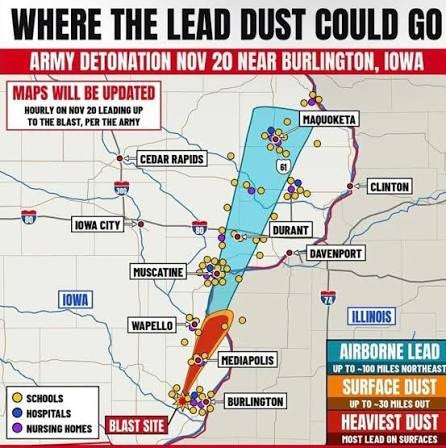
Potential Public Health Concerns
The primary potential exposure pathways include:
Airborne exposure: Breathing in lead-containing particles following the detonation.
Surface exposure: Contact with or ingestion of lead dust deposited on soil, playgrounds, vehicles, buildings, and other surfaces.
Lead is a toxic metal that can cause serious health effects. No safe level of lead exposure has been identified. Young children and pregnant women are at particular risk.
Recommended Public Health Precautions
Local public health agencies are encouraged to share the following recommendations with residents in potentially impacted areas:
Stay indoors: Avoid outdoor air by staying indoors on the day of the detonation. Keep windows and doors closed for 24 hours after the detonation as a precaution, unless updated official guidance indicates otherwise.
Use indoor air recirculation: Residential furnaces may continue operating. Facilities with outside air intakes, including schools and commercial buildings, should consider temporarily switching to recirculation when safe.
Improve indoor filtration: Consider using a portable air cleaner equipped with a HEPA filter.
Monitor official updates: Follow local news and the U.S. Army’s website for plume updates and safety instructions.
Clean surfaces safely: Once the U.S. Army determines the airborne exposure period has ended, wet-clean potentially affected surfaces, including playground equipment, toys, and windowsills, using soap and water. Avoid dry sweeping that may redistribute dust. Consider washing your vehicle and replacing the cabin air filter if needed.
Limit unnecessary travel: Avoid potentially affected areas when possible. Use vehicle air recirculation if driving through impacted areas.
Practice good hygiene: Wash hands before eating or drinking and remove shoes when entering homes to limit tracking dust indoors.
Seek medical guidance: Contact a healthcare provider if you have concerns about health-related effects from lead exposure.
Recommended Precautions for Schools and Child Care Facilities
Outdoor Activities
Keep children indoors during the potential exposure period.
Reschedule recess, outdoor physical education, playground activities, field trips, and other nonessential outdoor activities.
Avoid outdoor activities in areas identified on the Army’s maps until the airborne exposure period has ended and any surface contamination concerns have been addressed.
Child care providers should take additional precautions to limit outdoor exposure for infants, toddlers, and young children.
Building Ventilation and Indoor Safety
Keep exterior windows and doors closed during the potential exposure period.
Turn off or place heating, ventilation, and air conditioning (HVAC) systems in recirculation mode, minimize outdoor air intake, and maximize indoor air filtration during the potential exposure period.
Minimize unnecessary entry and exit while the plume may be passing through the community.
Transportation and School Operations
Avoid unnecessary travel through potentially affected areas during the exposure period.
Reschedule field trips, outdoor events, and nonessential transportation.
School buses and other vehicles traveling through affected areas should keep windows closed and use air recirculation when appropriate.
Administrators should review transportation, dismissal, and parent pickup plans in case the exposure period overlaps with normal school operations.
Schools and child care providers should coordinate with local emergency management and public health officials regarding any necessary adjustments to operations.
Cleaning Playgrounds and Outdoor Surfaces Following the detonation, lead-containing dust may settle on outdoor surfaces within affected areas.
After the U.S. Army determines the airborne exposure period has ended, assess the need to clean potentially exposed surfaces.
Wet-clean frequently touched surfaces, including playground equipment, outdoor toys, tables, chairs, handrails, and exterior windowsills.
Avoid dry sweeping, leaf blowing, or other activities that may redistribute dust.
Wash children’s hands with soap and water after potential contact with outdoor dust and before eating or drinking.
Keep children away from suspected contaminated surfaces and outdoor play areas until appropriate cleaning or assessment has occurred.
Consult local public health or environmental officials if significant dust deposition is suspected or additional cleanup guidance is needed.
Communication With Families and Staff
Inform parents, guardians, and staff about planned precautions and any changes to outdoor activities or transportation.
Encourage families to monitor official information from the U.S. Army and local emergency management.
Parents concerned about possible lead exposure should consult their child’s healthcare provider or local public health agency regarding whether blood lead testing is appropriate.
Follow any additional protective actions or evacuation instructions issued by emergency management authorities.
If I had children, no even if I was there, I would be getting in a car and evacuating for awhile.
America….cares very little for their people.